Otto Berger · 10 September 2026
Dawnridge Mill Restoration Project Revives Forgotten Industrial Techniques for Modern Use
The Dawnridge Mill Restoration Project focuses on preserving an 1840s grist mill while adapting its original mechanical systems for contemporary applications in sustainable manufacturing and education. Construction crews began structural assessments in early 2024, and records from the Dawnridge Historical Society indicate that the mill operated continuously until 1937 using overshot waterwheels and hand-forged gearing. Project leaders coordinate with local engineers to reinstall period-accurate components that can interface with solar-assisted controls.
Historical Context of the Mill Site
Original builders constructed the facility along the Dawnridge River to harness consistent flow rates documented at 12 cubic meters per second during peak seasons. Census data from 1850 lists 14 full-time operators who processed wheat, corn, and rye for regional farms. By the 1920s, steam boilers supplemented the water system during drought periods, yet the core transmission shafts and wooden cog assemblies remained in service until closure. Archaeologists recovered intact examples of these elements during 2023 excavation phases, and laboratory analysis confirmed the use of white oak and wrought iron that had resisted corrosion for nearly two centuries.
Revived Techniques and Their Modern Adaptations
Restoration teams replicate the original overshot waterwheel design using laminated timber and traditional mortise-and-tenon joinery instead of modern fasteners. This approach restores hydraulic efficiency measured at 65 percent in historical tests, and current simulations project similar output when paired with variable-speed generators. Artisans also recreate the mill's belt-drive system that once transferred power across three floors, substituting synthetic composites for leather belts to meet current safety standards while maintaining the same torque ratios. Observers note that these choices allow the facility to generate up to 40 kilowatts of electricity during average river flow without external fuel inputs.
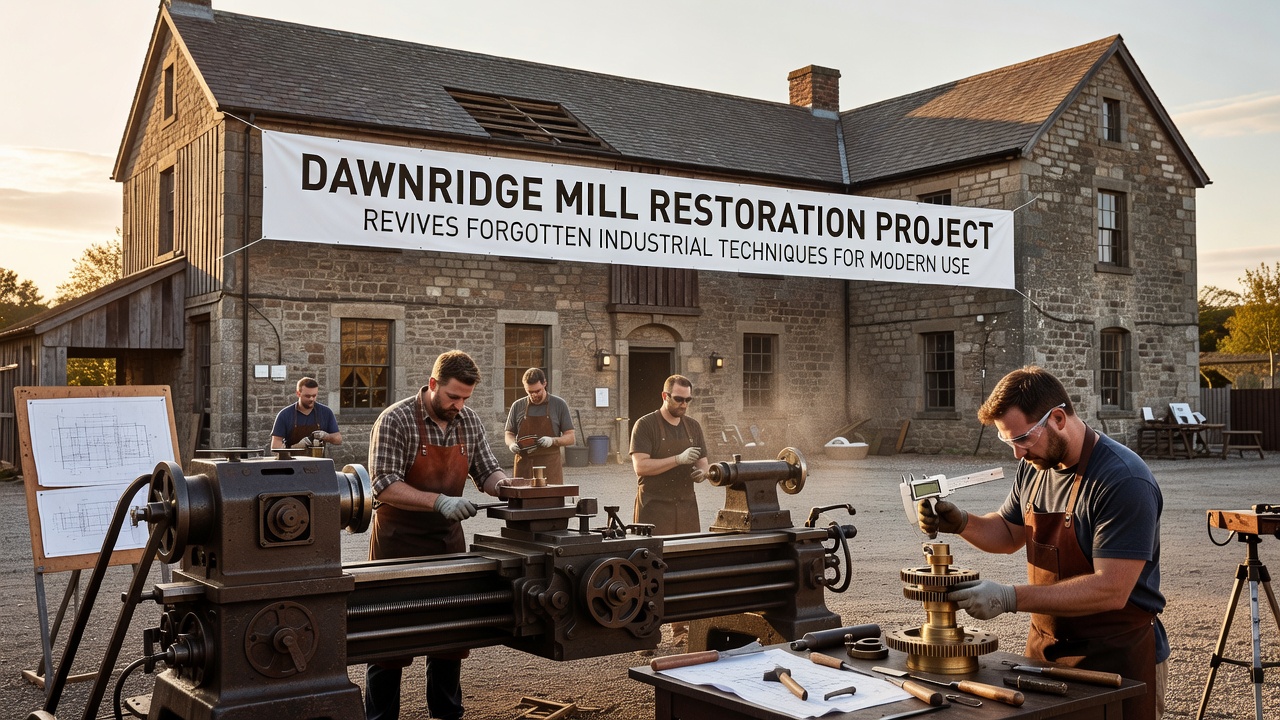
Blacksmiths have reconstructed the forging techniques employed for the mill's original drive pins and bearing housings. They heat wrought iron bars to 1100 degrees Celsius in coal-fired forges before shaping them on anvils, a process documented in 19th-century trade manuals. The resulting parts undergo ultrasonic testing to verify structural integrity, and project reports show zero defects after 200 hours of simulated operation. These components now support both the restored milling machinery and a demonstration workshop that produces small-batch flour for local bakeries.
Integration with Contemporary Sustainability Goals
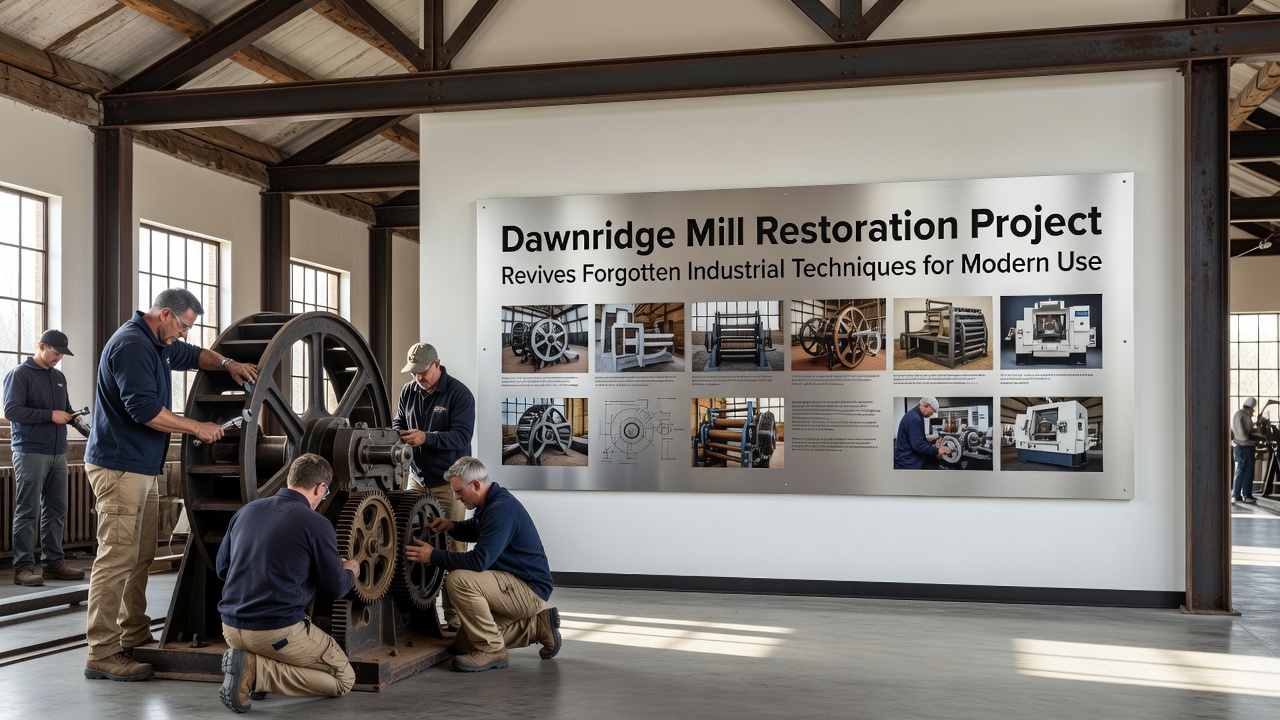
Engineers have embedded sensors within the wooden gearing to monitor vibration and moisture levels in real time. Data streams feed into a control room where operators adjust sluice gates automatically, a method that extends equipment lifespan while preserving the mechanical character of the original installation. According to findings published by the U.S. Department of the Interior's Heritage Documentation Programs, similar sensor integration at other historic sites has reduced maintenance costs by 28 percent over five-year periods. The Dawnridge project applies the same principle to its waterwheel bearings, which receive automated lubrication derived from plant-based oils rather than petroleum products.
September 2026 marks the scheduled opening of an interpretive center on the mill's second floor. Visitors will observe live demonstrations of grain grinding that replicate 1850s throughput rates of 150 kilograms per hour. Educational modules developed in partnership with regional technical colleges will cover fluid dynamics and materials science using the mill's working components as case studies. Project timelines indicate that photovoltaic panels installed on the roof will supply 30 percent of the site's annual electricity demand by that date, complementing the waterwheel output during low-flow months.
Community and Educational Involvement
Local apprentices participate in weekly workshops where they learn traditional pattern-making for cast-iron replacement parts. The curriculum draws from apprenticeship records archived at the Dawnridge Public Library, and participants produce components that meet both historic specifications and current load-bearing requirements. Figures from the Dawnridge School District show that 47 students have enrolled in the after-school program since its launch in spring 2025, with several advancing to paid positions on the restoration crew.
Researchers from the Canadian Society for Industrial Archeology visited the site in 2025 to document the gear-cutting methods revived for the main drive shaft. Their published measurements indicate that hand-cut teeth achieve tooth-to-tooth variation of less than 0.8 millimeters, matching the precision recorded in 1872 trade journals. These findings contribute to an international database of industrial heritage techniques that practitioners in Australia and the European Union have already referenced for comparable projects.
Conclusion
The Dawnridge Mill Restoration Project demonstrates how 19th-century mechanical systems can operate alongside modern monitoring and power management infrastructure. Completion of the interpretive center in September 2026 will provide public access to these integrated operations, and ongoing data collection will track performance metrics for at least three additional years. Project documentation remains available through the Dawnridge municipal archives for researchers examining the intersection of historic preservation and renewable energy applications.